If you've ever built a checkout page, an e-commerce plugin, or a subscription billing flow, you already know the pain: you need to test the payment form dozens of times, but you don't want to use a real card and you definitely don't want to accidentally trigger a live charge. That's exactly the gap a card generator fills. It produces number sequences that are structurally valid — meaning they pass the same mathematical check real card numbers use — without being tied to any real account, bank, or cardholder.
In this guide, we'll explain how card generators work, why they're a standard part of software QA and developer workflows, how to use FastestChecker's Card Generator the right way, and the safety and legal boundaries every developer should know.
What Is a Card Generator, Exactly?
A card generator is a utility that produces numeric strings formatted to look like real payment card numbers — matching the correct length, the correct Issuer Identification Number (IIN) prefix for a given network (Visa, Mastercard, Amex, etc.), and passing the Luhn checksum algorithm used to catch typos in real card numbers.
Crucially, these generated numbers are not linked to any real bank account, cardholder, or funds. They cannot be used to make a real purchase, and any attempt to use them for one will simply be declined by a payment processor. Their entire purpose is structural: to let software correctly recognize "this looks like a card number" during testing.
Why Developers and QA Teams Use Card Generators
- Testing checkout UI: Verify that input masking, auto-formatting, spacing, and card-type detection (such as dynamic Visa, Mastercard, or Amex icon switching) function seamlessly and accurately in real-time as a user types into the payment fields.
- Validating form logic: Confirm that your frontend validation scripts correctly reject malformed or incomplete credit card numbers while seamlessly accepting properly formatted, Luhn-compliant values before any data is sent to a live payment gateway.
- Automated test suites: Feed consistent, reliable, and repeatable dummy card data into automated unit, integration, and end-to-end test pipelines without relying on live sandbox APIs or risking network rate limits for every test run.
- Training and demos: Effortlessly populate staging and demo environments, interactive tutorials, or sales walkthroughs with realistic-looking placeholder payment information instead of leaving ugly blank fields or generic dummy text.
- Database and load testing: Effectively stress-test your backend infrastructure, database models, and payment processing pipelines by simulating large-scale data imports, verifying how your system securely stores, masks, and displays card-like information under heavy traffic.
How the Luhn Algorithm Works (In Plain English)
Every major card network number ends in a check digit calculated using the Luhn algorithm, a simple checksum formula from the 1950s still used today. It works like this:
- Starting from the rightmost digit (the check digit), double every second digit moving left.
- If doubling a digit produces a two-digit number, add those two digits together (e.g., 8 × 2 = 16 → 1+6 = 7).
- Sum all the digits (the doubled ones and the untouched ones).
- If the total is a multiple of 10, the number is Luhn-valid.
This is why a real card number can't just be "any 16 digits" — and why a proper card generator has to calculate a correct check digit rather than picking one at random.
How to Use FastestChecker's Card Generator
- Navigate to the tool: Go directly to the Card Generator tool on the FastestChecker platform to access the credit card testing interface.
- Select card network: Choose the specific card network or type you want to simulate (such as Visa, Mastercard, American Express, Discover, or JCB) based on its standard Issuer Identification Number (IIN) prefix requirements.
- Specify generation quantity: Choose exactly how many test card numbers you need generated at once, whether you require a single number for quick UI checks or a batch for database seeding.
- Copy and integrate data: Easily copy the newly generated Luhn-valid card numbers directly into your automated test scripts, staging checkout forms, or demo data seeds with a single click.
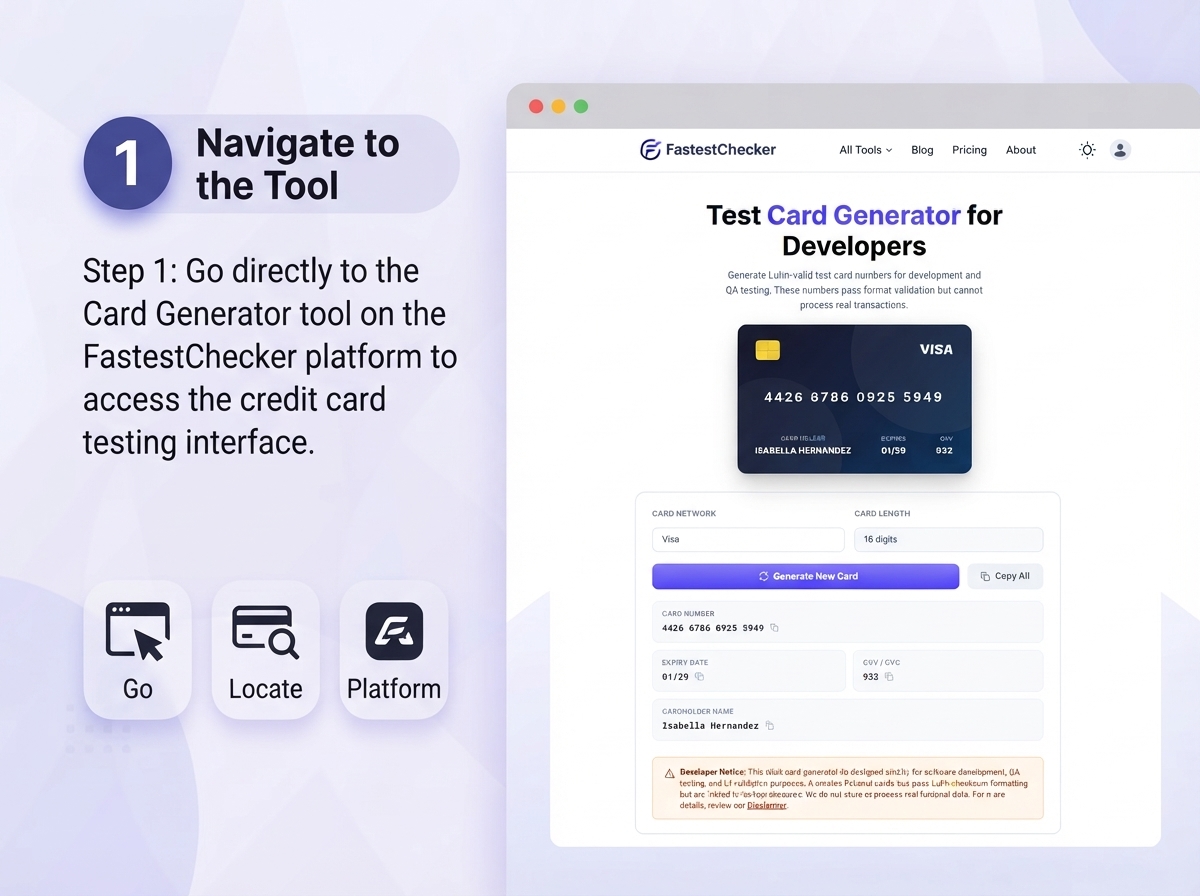
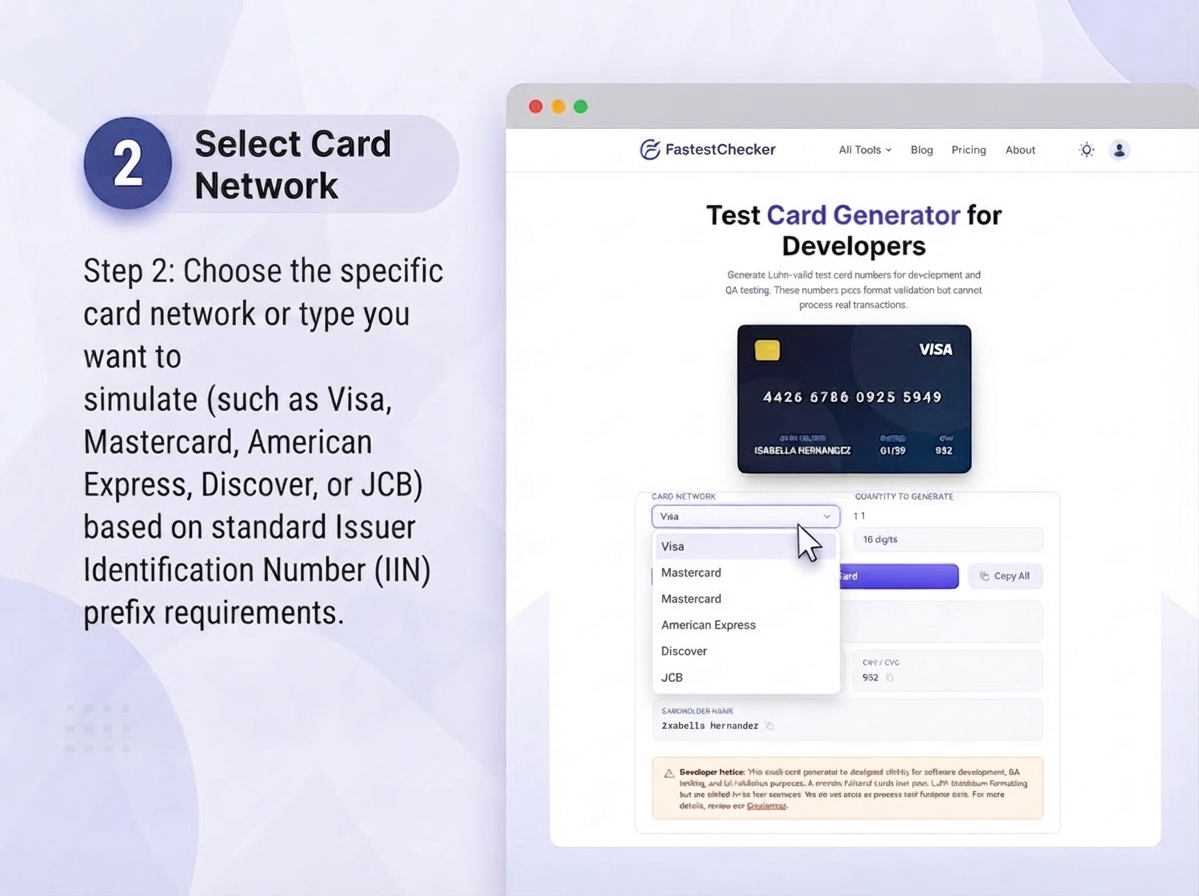
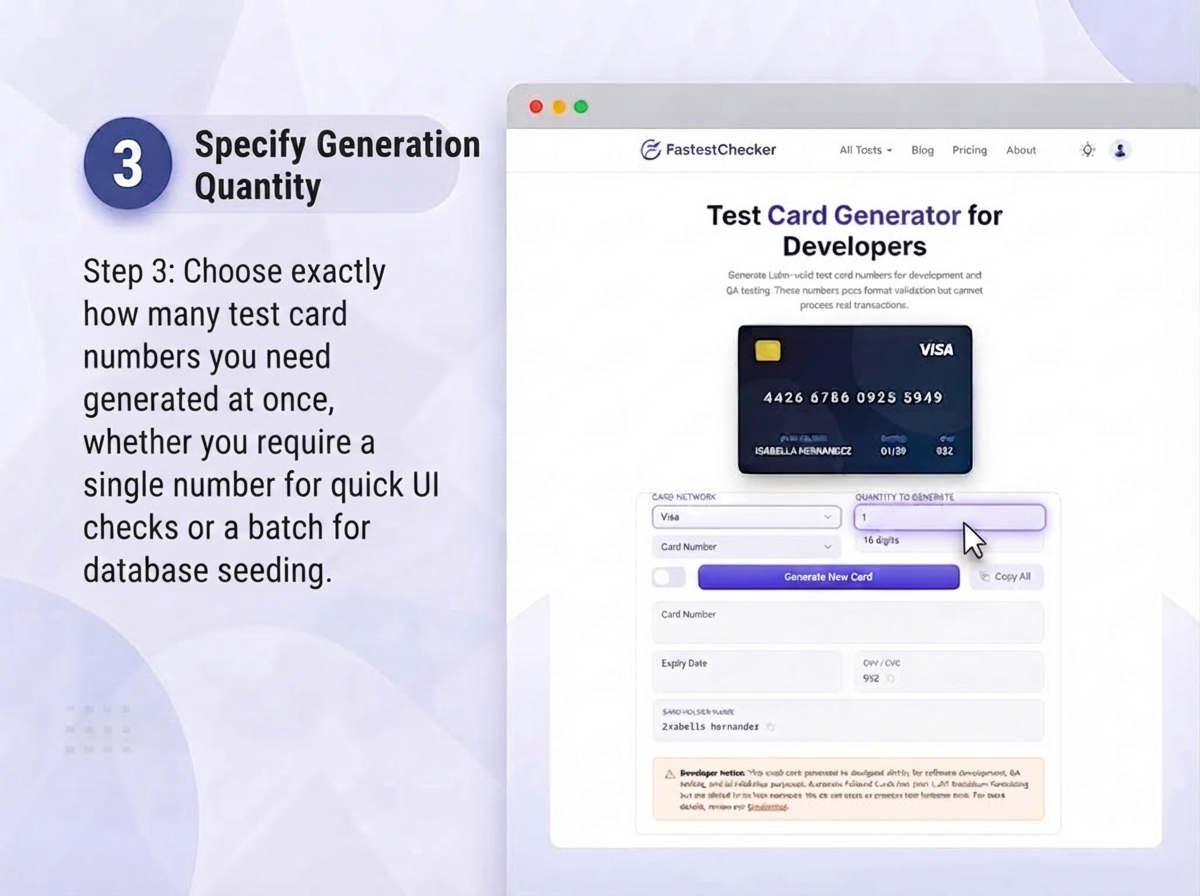
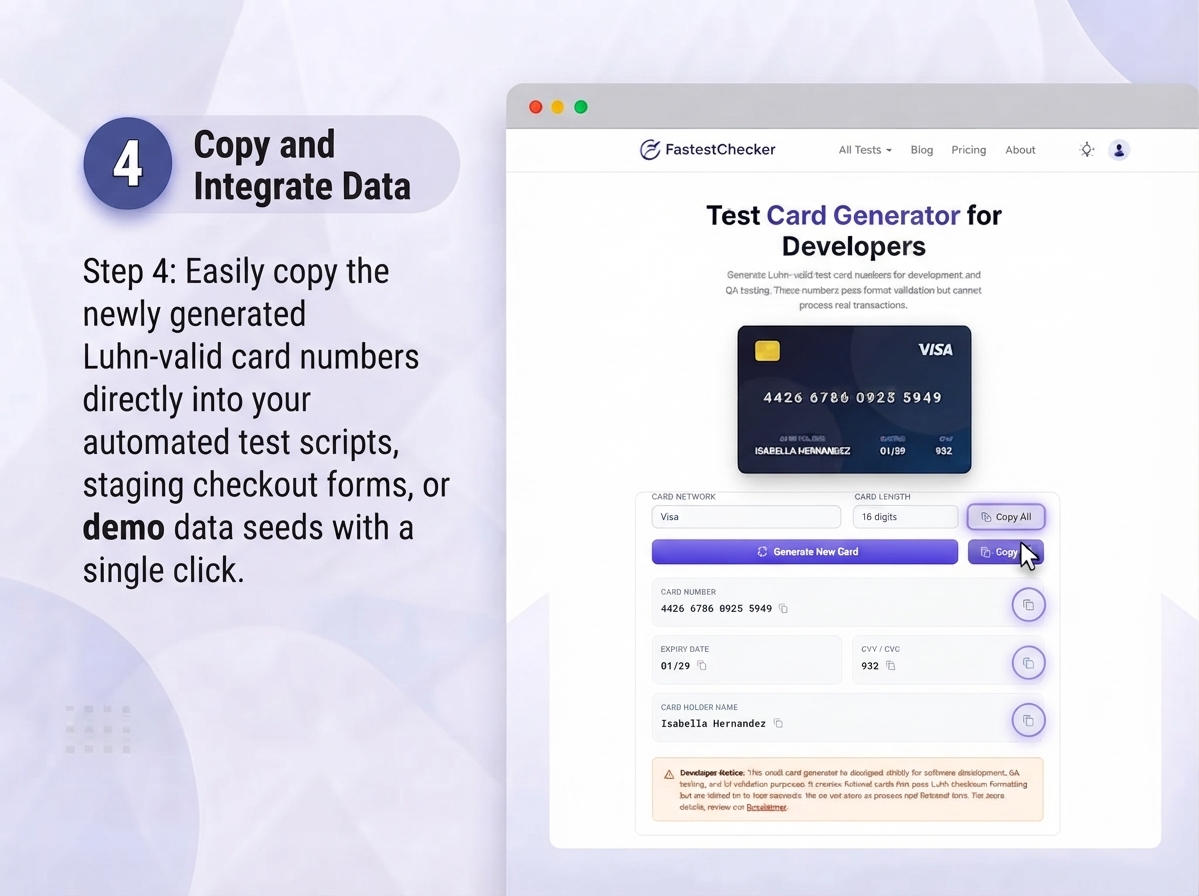
Every number produced passes the Luhn check and matches the correct prefix/length pattern for its network — but again, none of them are connected to a real financial account.
Card Network Formats at a Glance
| Network | IIN Prefix | Length |
|---|---|---|
| Visa | 4 | 16 digits |
| Mastercard | 51–55, 2221–2720 | 16 digits |
| American Express | 34, 37 | 15 digits |
| Discover | 6011, 65 | 16 digits |
Responsible Use: What Card Generators Are NOT For
It's worth being direct about this. Card generators exist for legitimate software testing — not to attempt fraudulent purchases, bypass free-trial checks, or fake identity verification. Generated numbers will never carry real funds and are routinely blocked by fraud-detection systems the moment they're attempted on a real payment form. Misusing them is both pointless (they don't work for real transactions) and illegal in most jurisdictions if the intent is to defraud a merchant. Use this tool strictly for development, QA, and educational purposes on your own test environments.
Rounding Out Your Testing & Dev Toolkit
A checkout flow involves more than just card number formatting. A few other FastestChecker tools that pair well with this workflow:
- Use the Email Validator to make sure your billing form correctly catches malformed email addresses during the same test pass.
- Run your checkout page through the PageSpeed & Web Vitals Checker — slow-loading payment pages are one of the biggest causes of cart abandonment.
- Check your Website Age & WHOIS Checker if you're vetting a third-party payment plugin's parent domain before installing it.
- Generate secure test account passwords for staging environments with the Password Generator.
Final Thoughts
A good card generator is a small tool that saves real development time — it removes the friction of manually inventing plausible-looking numbers and reduces the risk of accidentally testing with sensitive real data. Used the way it's meant to be used (staging environments, form validation, automated tests), it's a standard, safe part of any developer's or QA engineer's toolkit.
The Luhn Algorithm (MOD 10) Checksum Specification
Credit and debit card numbers are validated mathematically using the Luhn Algorithm (also designated the Modulus 10 or MOD 10 algorithm), standardized under ISO/IEC 7812-1. To verify a PAN (Primary Account Number):
- Starting from the rightmost check digit and moving leftward, double the value of every second digit;
- If doubling results in a number greater than 9 (e.g. $8 \times 2 = 16$), sum the individual digits of the product ($1 + 6 = 7$) or subtract 9;
- Sum all transformed digits together with the untouched digits;
- If the total sum modulo 10 equals 0 ($\sum \pmod{10} = 0$), the card number possesses a mathematically valid checksum.
Major Industry Identifier (MII) & IIN Prefix Hierarchy
| Payment Network | MII Prefix Range | Standard PAN Length | Security Code Format |
|---|---|---|---|
| Visa | 4 | 16 digits (historically 13) | 3-digit CVV2 (on back) |
| Mastercard | 51 - 55, 2221 - 2720 | 16 digits | 3-digit CVC2 (on back) |
| American Express | 34, 37 | 15 digits | 4-digit CID (on front) |
Developers testing payment gateways (Stripe, Adyen, Braintree) must use standardized test credentials rather than live card numbers to comply with PCI-DSS 4.0 requirements.
Frequently Asked Questions
Can I use a generated card number to make a real purchase?
No. Generated numbers are not linked to any real bank account or funds, so they will always be declined by real payment processors. They only pass basic format and checksum validation, not actual transaction authorization.
What's the difference between a card generator and a payment gateway's sandbox test cards?
A generic card generator produces Luhn-valid, correctly formatted numbers for frontend and form testing. A payment gateway's official sandbox test cards (like Stripe's or PayPal's) are specific numbers their own test systems recognize to simulate successful charges, declines, or errors — use those for actual gateway integration testing.
Is it legal to use a card generator?
Yes, when used for legitimate purposes such as software testing, QA, and education on your own systems. Using generated numbers to attempt fraud or deceive a merchant is illegal and, in any case, will not succeed since the numbers carry no real funds.
Why do generated numbers need to pass the Luhn algorithm?
The Luhn algorithm is the same checksum used by real card issuers to catch simple typos. If your test numbers don't pass it, they won't accurately simulate how a real, correctly-typed card number behaves in your validation logic.
Muhammad Asad Arshad is the Founder and Lead Software Architect of FastestChecker, specializing in client-side Web APIs, cryptographic standards, and network diagnostics.